
AI Agents for Distributors
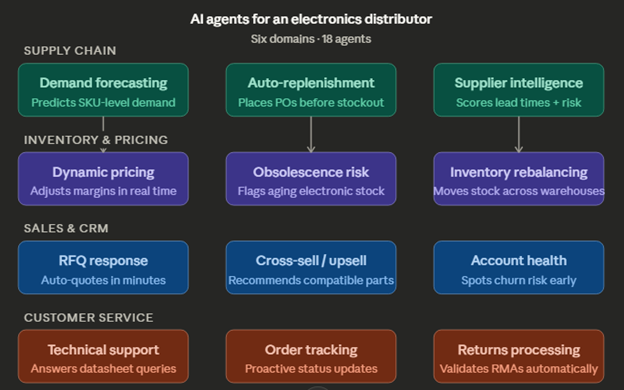
A distributor sits at a fascinating intersection of supply chain, commerce, and technical complexity. Here’s a comprehensive map of every AI agent that could be built. Here’s a breakdown of all 18 agents across 6 domains — click any box in the diagram to go deeper on any one.
Supply Chain (teal)
The demand forecasting agent is usually the first one built — it ingests sales history, seasonal patterns, competitor pricing, and component lead times to produce SKU-level predictions. Electronics is particularly tricky because a new product launch (say, a new GPU generation) can make adjacent SKUs obsolete overnight. The auto-replenishment agent acts on those forecasts, automatically generating purchase orders before safety stock is breached — it negotiates quantity breaks and bundles orders to hit MOQs. The supplier intelligence agent continuously tracks which manufacturers and brokers are reliable, scoring them on fill rate, lead time variance, and geopolitical exposure (critical for semiconductors sourced from Taiwan or Korea).
Inventory & Pricing (purple)
Electronics inventory has a ticking clock on it. The obsolescence risk agent monitors product lifecycle data — end-of-life announcements, datasheet changes, component discontinuations — and flags items that need to be cleared before they become worthless. The dynamic pricing agent adjusts sell prices based on stock levels, competitor prices scraped from the web, and customer segment. The inventory rebalancing agent looks across multiple warehouses and moves stock to where demand is concentrated, rather than letting one location hit zero while another overstocks.
Sales & CRM (blue)
The RFQ response agent is arguably the highest-ROI agent for a B2B electronics distributor. Customers send requests for quotation — sometimes with hundreds of line items — and the agent can respond in minutes instead of days by checking live stock, applying customer-specific pricing tiers, checking lead times, and generating a formatted quote. The cross-sell/upsell agent analyzes a customer’s BOM (bill of materials) and suggests compatible components they’re probably buying elsewhere. The account health agent watches order frequency, payment patterns, and support ticket volume to surface churn risk before it’s too late.
Customer Service (coral)
Electronics distributors field highly technical queries — “is this capacitor compatible with this board?” or “what’s the derating curve at 85°C?” The technical support agent is trained on datasheets, application notes, and past support tickets to answer these without a human engineer. The order tracking agent proactively pushes updates instead of waiting for customers to call. The returns agent handles the RMA (Return Merchandise Authorization) workflow — verifying warranty status, generating labels, routing items to inspection or refurbishment.
Finance & Compliance (amber)
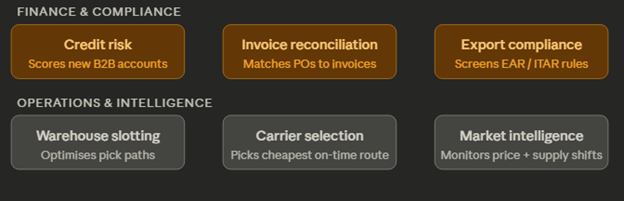
The credit risk agent scores new B2B customers requesting Net-30 or Net-60 terms, pulling from credit bureaus, trade references, and payment history. The invoice reconciliation agent matches supplier invoices against purchase orders and goods receipts — a mundane but expensive problem when you’re processing thousands of invoices a month. The export compliance agent is critical for electronics specifically: many components (certain chips, encryption modules, RF equipment) are controlled under US EAR or ITAR regulations. This agent screens every order against the denied parties list, checks ECCN classifications, and flags anything needing a license.
Operations & Intelligence (gray)
The warehouse slotting agent optimizes where SKUs are physically located in the warehouse based on pick frequency — placing fast-movers near packing stations to cut travel time. The carrier selection agent picks the optimal shipping method for each order given cost, speed, fragility (ESD-sensitive components), and customer SLAs. The market intelligence agent is a continuous web scraper and analyst — monitoring distributor pricing, component spot market prices (especially important for semiconductors), and supply shortage alerts.
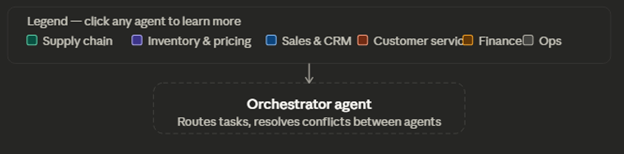
The orchestrator sitting at the bottom is the hardest piece to build but unlocks the most value — it’s the agent that routes incoming tasks to the right specialist agents, resolves conflicts (e.g., the pricing agent wants to discount a SKU the inventory agent flagged as scarce), and maintains a coherent state across the whole operation. Think of it as the “chief of staff” layer. Most teams build individual agents first and add orchestration later once the specialists are proven.





There are no comments yet.